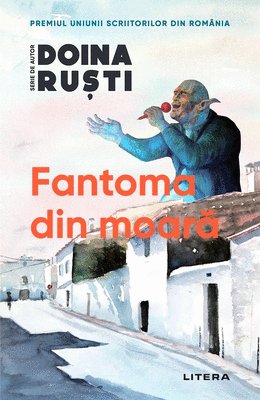


trans: Ileana Marin, professor, University of Washington, Seattle
The novel has been translated into German and Hungarian.
eds: Polirom, Iasi, 2008, 2017; Klak, Berlin, 2018; Litera, București, 2024, Orpheusz, Budapest, 2024
115.000 words/ 420 pag
Copyright: Doina Ruști
Romanian Writers' Union Award - for prose. 2008
Last year, sometime in November, I noticed a book in the window of the Sadoveanu Bookshop. It stood out because of the large Arial-font letters of its title: The Secret Life of Adela Nicolescu as Told by Florian Pavel. I stopped short, my eyes fixed on the glass. My name was there, on a navy-blue cover, displayed as I had never seen it before.
Perhaps it was a coincidence. I read the title again and went inside.
The counter was crowded with books, but all I could see was my name. I opened the book with the uneasy feeling that everyone was watching me. A sudden heat spread through my head. This book was about me. I knew it from the first page, and now, after reading the entire novel, I know it for certain.
On the November day, seemingly suffocated by the last sun of autumn, I bought the book and ran home with it. I turned on the air conditioning, curled up in an armchair, and only then began to read:
That spring, even though Del didn’t fully understand that the
world was changing, she knew her emotions had emerged from that
dangerous place of fundamental transformations. One evening,
after spending the day with Tantilen as usual in the kiosk in the
yard, she went inside with the feeling that something bad was
happening. The place was deserted, as though everybody had died.
The mirror in the vestibule was missing and the oil lamps wereturned off. Through the gap in the crimson drapes, the familiar
image of Ion Nicolescu with his Diplomat top hat and lionhead
walking stick looked out straight ahead from a golden frame.
Piercing the dark, Del sneaked into the bedroom. Nothing of what
she’d known was left. Neither the beds nor the three-door
wardrobe remained, but there was a small round table which she
seemed to have seen somewhere before. And some chairs. Warm
evening light streamed through the tall windows. Del took a step
toward a bench, bright green like most of the chairs in the
house, and made herself comfortable there, thinking that if she
closed her eyes and waited for a while, a miracle might bring
back all that had disappeared. She didn’t wait long — or maybe
time simply compressed; anyway, after a bit, she sensed a
presence, a smooth step sliding along the walls. Expecting
to see her mother, grandmother, or somebody else, she peeked
through her eyelashes. Then she opened one eye. Next to one
window was a man — a dwarf with short legs and a wrinkled head
that seemed to be made of balled-up paper. Del shivered. The
little man had bright, restless eyes, but Del couldn’t say what
made them look that way. He was a frightening, ugly little man
with big eyes, a thick jaw, and a crooked nose that looked like a
piece of wood cut and polished with a blade. His bright aura made
it seem as though a huge spotlight was trained on him.
“Maybe I’m not as you thought,” he growled in a labored voice.
The words escaped his burrow-like mouth guarded by squirming
slugs.
“Maybe I’m not exactly as you thought,” he repeated almost
mockingly.
“But I assure you it’s me. You wanted to see me. Here I am.”
Del understood every single word. Later in life, in moments of
calm solitude, she would relive in detail the fear, the warm
revelation, and the immense disgust at thinking all her hopes
were reduced to the image of this hideous dwarf, a result of the
complex situation she lived in now and which blocked her every
attempt to speak or move. The dwarf smiled, and the flesh on his
face trembled. On his forehead were two bumps, or two ears, as
small as Del’s little fingertips. This discovery made her laugh.
Not for a moment did she think she was talking to the Devil. She
was certain the dwarf was the Other One, the good one.
“I am God. Don’t you forget me,” he confirmed, and rose toward
the tall ceiling, becoming taller and thinner. He transformed
himself into a transparent wisp within the shadow that spread
across the room at sunset.
After a while, Grandma found Del and took her to the room
which they had just remade into the child’s bedroom. This room
was smaller. It was where they used to keep the lavatory and the
dresser with bedsheets.
“Well, I set up a room here just for you; you are a big girl
now and can’t hang around your parents all the time. You must
sleep alone. Come, come, nothing bad will happen to you, this
door opens into their bedroom and this other one leads to mine,
out this window you see the people in the street and, if you have
good eyes, you can see Iulica’s garden; now, it’s better for you
to have your own room, to learn to make the bed, to fold your
things neatly, to take care of yourself during the night, to
cover yourself, to wrap yourself into the blanket. One of these
days you’ll go to school and here you’ll do homework, here you’ll
keep your copybooks — and the books will fit on these shelves.Then you’ll see how nice it is to have your own room where nobody
disturbs you. Many kids would love to have their own room, but
they are crammed with the rest of their families into one room
with a dirt floor, or maybe a cement floor covered with linoleum
— not many houses have a proper floor. How many people do you
think live like us? Other poor suckers can hardly make it.”
“I don’t want to go to school.”
“Who said you would? It’s a holiday now. Till Easter.”
“You. You just said it. And you should know that I met God.”
Del’s grandma sighed and continued talking about what she
thought was important.
“Well, we have a lot to do, and I’m counting on you to shell
walnuts for the coliva… you know, the memorial cake. Tomorrow we
commemorate my father-in-law and early in the morning you and I
will go to the cemetery, because Tantilen has caught a cold. You
know she is sick and old. Close the door and hold on to my skirt
till we get down to the stable where we’ll crack the nuts.”
In midsummer, Cristina was born, and Del’s world was filled
with unexpected — and unwelcome — new details. Everybody in the
house went crazy when Ica gave birth to the second child. They
held a feast with tables set in the yard, lots of people, and
plenty of fine dishes. They all forgot about the other kid. Del
hung around, putting up with people’s questions. Then she sat
next to Mrs. Predescu, a stuck-up lady, who only talked about how
one should do things: one must hold a fork this way, one must
keep one’s handkerchief there, a girl should smooth out her dress
from time to time.
In the evening, Del sneaked out to the big backyard oven where
they had baked bread all day long. The oven was still warm. Shewent inside, sat on the nicely swept hearth, leaned against the
back wall with no concern for her white silk dress, and began
staring at the sky where the moon had risen to its fullest. It
was then that her God descended a second time.
It wasn’t quite like that, and as for calling myself Del, this shortening of my long and somewhat old-fashioned name happened later. But this is not essential to the story. What struck me in the first chapter was its familiarity with intense events. And with Grandma, whom I haven’t thought of for quite a while. She was a short woman, about five feet tall, with a brown lizard-like face, all wrinkled. It seemed pinned there by her huge black eyes which she often rolled, like Bette Davis, her favorite actress. I remember how in the 1960s, while we both breathlessly watched movies in which Bette Davis played diabolical women, Grandma would read the subtitles aloud, stressing all the inflections and mimicking the character’s grimace—sometimes standing up. She always had a velvet band on her head, either green, black, dark purple, or burgundy—to hold back her bowl-
cut hair. She wore all kinds of extravagant dresses with a belted waistline and a bust decorated with bizarre flounces, lace, and patterns. There was a big wardrobe in nearly every room and almost all of them were filled with her clothes. Many were made between the wars, but from time to time, she would have some sewn by Mrs. Dobrescu, who lived two houses down from us. I remember Grandma always in motion, running around in large, flowery housedresses; in slippers usually one size too large, or in hellishly high heels; all wrapped up in her sophisticated dresses with yellow-and-green stripes; and in checkered but mostly mustard-brown coats—while giving orders to everyone. In our home, there were always many people, people who regularly called on us or who just came by. Relatives, and the omnipresent Lache Ogaru, a thin old man with a long nose who continuously had a story to tell with his unmistakable voice, and who called me from whichever room I was in and who usually came at 5 P.M. to drink coffee with Grandma, whom he used to call Iozefina with imperial emphasis. I remember him wearing his straw hat with the black grosgrain ribbon, with his whitish cane—excessively formal—bowing to all his listeners, even to me. Anytime he was telling a story, he seemed tied by a silk thread to whomever was listening. It was the busiest time of the day when all kinds of people came by to say hello to Grandma. Only rarely did any of them look for my grandfather, who preferred to stay on the veranda, in the kiosk, or on the stairs of the house in the long five o’clock hour. During the day, the frenzy was much more intense in the yard and around the kitchen.


