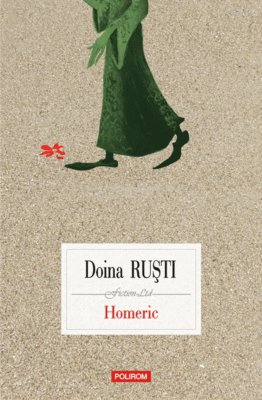
This page includes the plot and an excerpt from Homeric, the novel by Doina Ruști, published by Polirom in 2019, meetings with readers, events related to the novel, as well as excerpts from critical studies and reviews of Homeric, together with their sources. Authors include Mircea Buda, Paul Cernat, Elvira Sorohan, Dorica Boltașu, Serenela Ghițeanu, Pompilia Chifu, Oana Marinescu, Constantin Dram, Nora Dinu, Amalia Drăgulănescu, and others, with mentions in Evenimentul zilei, România liberă, and Libertatea
Critics about Homeric
Homeric stands as one of the most fascinating prose works of recent years—written with erudition and the literary technique of a jeweler, a kind of metatextual manifesto on the enduring power of Story, on the ineffable beauty of fiction, and on its capacity to rival reality in authenticity. All.
Dumitru Mircea Buda, Acta Marisiensis. Philologia
“If we look beyond the title – whose enigmatic subtext is left undeciphered until the end, Homeric is the novel of the world of Bucharest during Phanariot times, without precise historical determinations, but recreated with meticulous and charming authenticity: a feast of the senses and a rampancy of mythical elements – in a book of accursed passions and fatal charms, as if they came out straight out of the Eliadesque cellars on Mântuleasa Street.
At the core of the novel there are the tumulus and the forests of Cotroceni (which have meanwhile disappeared) inhabited by fantastical beings who live in herbage, such as the flower of divination ("the-blood-of-the-devil"), which opens doors to the world beyond. The life of the community is destabilized by the connections with the invisible creatures of the forest, which lead to mysterious disappearances. An entire world lives right in front of our eyes, fuelled by the magic of interwoven stories. From the myriad of characters, the fateful bastard lady, Miss Despina Băleanu, comes into focus, her real father an accomplice of the forest spirits. Then we have the unloved Mărmănjica, a Cinderella immunized by the potions of a doctor trained at Vienna, the strange painter Pantelimon Iorga, the irresistible fortune-teller Ciptoreanca, and the adventurer Ahmet, who had set sail in Levant and crashed at the Gates of the Orient, in this "chronicle of Băleni" sui generis... Perspectives change as if in a carousel of phantasms, and the reader becomes obsessed with the charm of a layered story.
Innate storyteller and owner of an imaginary land of her own, haunted by the ghosts of history and the "demons" of femininity, Doina Ruști catches the public eye through a whirlwind of imagination and reigns over a magical, reinvented, spectacular Balkanic realism, sung to the rhythms of the fantasy genre.”
Paul Cernat
“A new fabulous novel by Doina Ruști”
Evenimentul Zilei
“Homeric, by Doina Ruști — a mystery novel in a fantastic register. More here.”
Jurnalul.ro
The novel begins with an erotic aspiration, with that moment, in fact, when you do not yet know what you desire, but know with certainty that you want to possess, to gather up, with a kind of embarrassing greed, the terribly fragile wings of another being, one you do not even know. From there to the mystical territory where monsters, fairies and sprites live, there is only one step. And Homeric is the story of that step.
Doina Ruști, confession
“A new avant-garde novel by the writer Doina Ruști.”
România liberă
“It is a gripping book, with touches of noir detective fiction, written with energy and with deep knowledge of both history and place, as they were in times not exactly immemorial, yet whose historical dimension seems impossible to fit into a strict timeline. Why? Because its agglutination into the fantastic makes it almost impossible to place in a precise historical period — which is all the better, since what should interest the reader is not this aspect, but rather how Năltărogu becomes invisible, how Mărmănjica reads people’s minds, or how the seemingly humble coffee seller Mărin becomes perhaps the most important character in the book. Why? Read Homeric and you will find out everything, including the meaning of the enigmatic title chosen, not at all by chance, by Doina Ruști.” more
Gelu Diaconu, O mie de semne
“The novel Homeric can be read as an Oriental tale, an adventure novel, a Phanariot fresco, and a fantastic novel — yet it is all of these at once and more than their sum. Like the epic it playfully alludes to, it is a magical story about the World, about tumultuous destinies that eventually turn to dust. And the Narrator, who lives for hundreds of years yet grows old as well, acknowledges that the only thing that can endure is… the Story, that is, Literature.”
“Doina Ruști proves an extraordinary narrative gift, an exuberant imagination, rare erudition among today’s writers, and a wild sense of humor.” Read more
Serenela Ghițeanu, revista 22
“Her latest volume (Homeric) is a superb book which, after advancing slowly, gradually seizes and overwhelms the reader like a fantastic serpent. Apparently a novel set in the Phanariot world, yet without precise historical determinations, it is more deceptive than her other titles, because it describes states and feelings that belong to no specific era. A love story in an uncertain world. Places and customs described with astonishing precision and authenticity, a powerful imagination, and a blend of realism and magic so convincing that, after a while, the reader becomes convinced the world can only be as Doina Ruști describes it — speaking, under the appearance of a story set in a certain time, about eternal emotions.”
Stelian Țurlea, Mediafax
“Doina Ruști directs everything in her own way, revealing the center of the action through the novel’s construction as a game of narrated time. The four parts of the structure are ordered according to the time of events: present and past, introduced by a presentation of the focal characters and ending with ‘My Story’. The latter is a confession by the author, an unseen and nameless narrator, an original clause of remarkable narrative fluency.”
Elvira Sorohan, Observator Cultural
Doina Ruști is a writer who has chosen to build strange worlds, born half from phantasms and half from a Balkan cultural imaginary, extending common representations of reality into a game of overlapping, opaque-transparent, constantly deceptive realities. She creates a sui generis mythology of eros, of fatal passions, and of a Phanariot Bucharest around Gorgani and the edge of the Cotroceni forest.
Dorica Boltașu Nicolae, Literomania
Doina Ruști’s Homeric is a beautiful and finely written novel, a work of pure literature and a feast for the seasoned and passionate reader. It has been a long time since I read such an impeccably constructed book, one that keeps you until the last page.
The novel introduces three characters who gradually become masks of acute loneliness, within which there is only one salvation: an ideal pushed to extremes. At the center stands the love between Pantelimon and Despina, explored through an intelligently built intrigue that leads into a fantastic history of mysterious disappearances, a secret-filled forest, and the visionary character Mărmănjica.
What is spectacular is the way the story grows without revealing the resolution of its conflicts, while the narrator gradually becomes the main character, taking over the emotional weight of a love that began with two almost traditional figures.
The details of long-gone times, the touches between real and magical, the carefully built characters — all form an original and spectacular combination worth choosing from the multitude of recent Romanian books. Read the full article here.
Oana Dușmănescu, Libertatea
Whenever I read Doina Ruști’s books, besides the intellectual joy of a superb reading experience, I also feel a bitter regret… more
APort blog
When I entered this world, I was amazed by the sensory way it is painted in words. I didn’t just visualize it. Doina Ruști added two more layers: an olfactory one and another made of intertwined metaphors that give a new dimension and depth to visual perception. I often felt the need to reread passages — not to uncover hidden meanings, but to immerse myself in the rich layers created by these metaphors.
Oana Marinescu — Perspective
Doina Ruști creates suspense in an original way, making you eagerly await the next chapter in the hope that the mystery will be solved. A new detail always appears, leading to another story, until the final confession clarifies everything.
Adelina Sorescu — Semne Bune
A great creator of stories, Doina Ruști surprises with a construction of successive layers that complete one another from a distance until the final sequence — both explanatory and ambiguous. The novel shines through its exoticism, its fantastic frame, and a sui generis mythology, built around an unexpected love story. more
Constantin DRAM, Convorbiri literare
This superb novel begins like a theatre play…
I absolutely love the book! Homeric completely captivated me. The Romanian language gains so much color and charm here, the characters, places, scents and emotions keep you in suspense… It’s hard to stop reading. Thank you, Doina Ruști, for the joy of reading this book!
I finished reading Homeric, one of the most beautiful books I’ve read. Its narrative perspective and mythical characters reveal the magical dimension of the Universe and the human need to reconnect with it. It was a joy to read.
Diana Alexandra Dragoman
I think you are wonderful! I would recognize your style immediately. You made me rediscover the cultural imprint of the Ottoman world, the beauty of archaic words, and the fascination of history woven into fiction. I look forward to the next launch.
Petruța Condrea
I read and reread every page with fascination and admiration for the sweetness of the language and the thrilling atmosphere of the story.
Stefania Argeanu
The fantastic nature of this book made me spend an entire day in pajamas under the blanket. An absolutely wonderful novel that makes you forget to eat or even breathe. FB
Suzana Tănase
I finished reading Homeric, a novel that feels like pure poetry. A beautiful reconstruction of Phanariot Bucharest. A superb novel to read and love.
Luisa Ene — Instagram
Mystery and magic are part of the tools that seduce readers in Doina Ruști’s prose. Homeric invites readers into research, genealogy, and a meta-novel that must be pieced together through multiple rereadings.
Nora Dinu, Tradiții, arte și literatură
A captivating book that opens a window toward history and the souls of the people who lived here. Beware: behind sherbets and hookah smoke lie traps — and the danger of addiction to good literature. Recommended reading!
The author builds a fabulous geography of Bucharest where real and imaginary blend into the map accompanying the novel. Through disappearances, spirits, visions, and mythological elements, Homeric explores the interplay between reality and imagination and the dialogue between author and readers.
Homeric is an extended parable and an inverted apology of love, set in a dystopian Phanariot order. Its structure involves anticipations, returns, expansions and compressions of time within a space at once well-defined and elusive, on the edge of Bucharest, between the Cotroceni forest and the Gorgani district — a true triangulation of the miraculous real.
See also Critical Reception
and [BIBLIOGRAPHY]
Amalia Drăgulănescu — Journal of Romanian Literary Studies


