by Doina Ruști
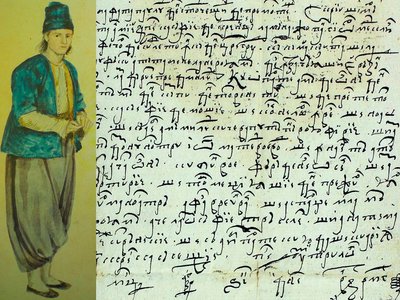
Toia—beautiful name, isn’t it? An eighteen-year-old fellow, dark-skinned and green-eyed, always wearing a flamboyant hat. Though nothing more than woven straw, it was ennobled by a strip of cloth that still preserved something of its original fire: no longer red, but a faded rose color, dusted over with a thin veil of street dust. On this ornament—like a little wreath rising toward the crown—were sewn all sorts of things: tiny buttons, coins and beads, small tin figurines, apple seeds, painted bone fragments, and other objects that over time had lost their shape and identity.
In any case, Toia was impossible to miss. The entire household knew him well, for he was a sort of jack-of-all-trades. He lived on the estate of the boyar Dumitrache Racoviță—roughly where the Capital Police stands today—in a large house with an upper floor and many wings, with outbuildings and a wide garden, just as it appears on a map by Poitevin-Skeletti that you can still find online.
Living in the very heart of the town and in such a grand household, he soon became known throughout the neighborhood as well. The people of Bucharest recognized him by his hat, while the folk of the mahala called him by name.
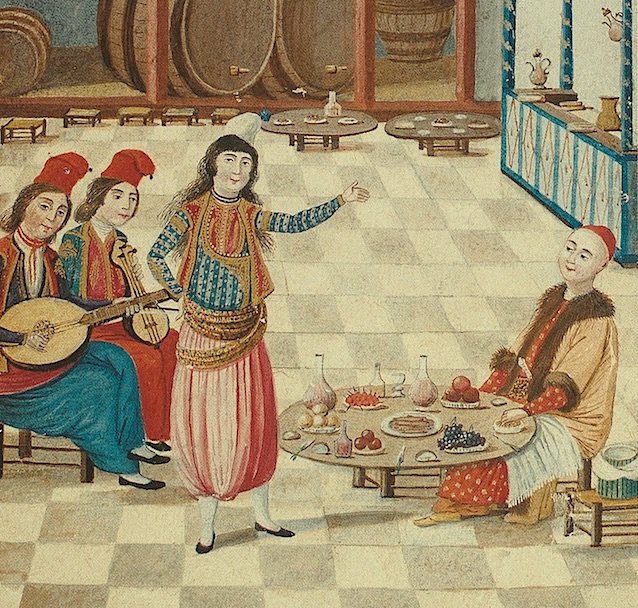
Racoviță himself had noticed him and sometimes, in the evenings, asked him to sing at the table. Toia plucked the cobza and had such a melodious voice that whatever he sang left a shimmer of tears on the lashes, making the idle listeners see him as gentler and kinder than he really was.
In truth, few knew what he was truly capable of.
For in his real world, small broods of dreams and whims were quietly growing. One day he was sent to buy coffee pots in the Outer Market, and it was then that Toia realized how large Bucharest truly was. He wandered through streets and alleys, gaping at the neighborhoods, and by evening found himself in Pantelimon—where another face of life was about to begin.
Near a gate he caught sight of Tranca—Dumitrana in the official records—a tall girl whose gaze struck him straight in the gut. Or rather, even lower.
Toia never returned to his master.
There was, however, a problem. The man with the baroque hat and a thousand dreams was a slave, part of the property of the boyar Racoviță—a princely lineage known for recovering every loss, even from the jaws of a snake.
And so the search began.
Toia had to be brought back home at any cost. Usually this was quite easy, for a slave was not only dark-skinned but often marked as well—branded with the master’s initial, tattooed, or sometimes with an ear notched in an artistic fashion. Yet let us not forget: Toia’s green eyes made him easier to hide in a mahala where many people were themselves dark-complexioned. Besides, by then Toia had become the husband of Tranca, a free woman with a good reputation in the neighborhood. They even had proper papers, so one might say he was now a fugitive slave who had managed to settle into ordinary life.
But let us think for a moment about poor Racoviță—a determined man, still young and full of expectations. He could not accept that one of his slaves had escaped. He felt robbed, even dishonored. He paid informers, offered rewards, and persisted in the search, until—after five years—Toia was captured.
By then he had four children, all legally the property of the great Racoviță, who opened a lawsuit through which I myself discovered Toia’s story.
At this point Alecu Moruzi enters the scene, ruler of the country at that time.
It is May 1794. Among the petitions received at the chancery lies one signed by Tranca. She does not complain about losing Toia, but about losing a child. Patiently she writes out her story, and we learn how happy those five years had been for her. One boy and three girls stood as living proof of that time spent beside Toia. And now Racoviță—a powerful boyar with titles and money—had decided to step into her life.
Still, the boyar was generous in his own way. He did not want all the offspring of his slave. He renounced the girls; they might remain with their mother. But Mavrodin, about five years old, seemed to him rightly destined for his household. He could already picture the boy keeping the drone beside his father during pleasant evenings at the manor.
As for Toia—there was no discussion. He would return “home” and be punished as an example.
Prince Moruzi read the petition and asked for further information about the case. Witnesses were brought in. Mavrodin passed from one side to the other. But Tranca stood firm. She had arguments, and a mouth that did not know how to fall silent. Above all, she was a free woman—and the entire mahala stood behind her.
People who sang in the evenings at Saint Pantelimon, who believed in him and called him the doctor without silver, came forward and swore on the cross that Mavrodin was not Toia’s child.
The Metropolitan was scandalized. Moruzi smiled.
“Then whose child is he?” the Metropolitan demanded.
“The Muscovites,” answered the chorus of the mahala.
Silence fell.
Between the boyar’s estate and the Pantelimon neighborhood forests seemed to grow, thick with wolves. Those old days flashed through the minds of the boyars in the Divan—the time when Bucharest had filled with wigs and Russians. So Tranca, it seemed, had danced through the streets in those days. Heated scenes crossed several minds at once; in some ears the sound of the piano still echoed faintly.
Racoviță accepted the explanation. Yes—he knew very well. During the Muscovite days he himself had stepped off the straight path, he admitted.
The boyars sighed. Moruzi kept smiling. And Tranca was finally free of her worries.
Mavrodin returned home with his mother. Life quickly settled back into its ordinary rhythm.
And somewhere, in a courtyard on Lipscani Street, Toia dreamed of those five years—the only freedom he would ever know.