The interview offered both a retrospective of this recent trajectory and a reflection on new forms of reading and dialogue with readers.
During the broadcast, Doina Ruști discussed the ways in which contemporary literature is increasingly opening itself to participatory reading, in which readers become active partners of the text. This theme was further explored in a report filmed at the meeting with readers during the YA Festival at Cărturești, where practices such as rewriting fragments of novels, creating films inspired by literary texts, and imagining new characters were discussed.
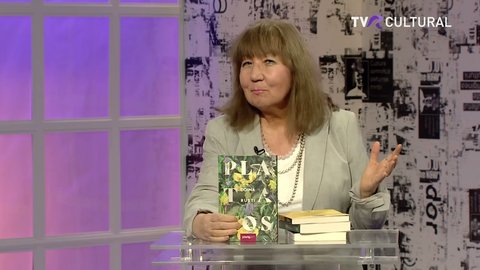
The novel Platanos, written at the request of students, was presented as a book with a strong social stake, despite its fantastic register. The text explores the idea of change and personal revolution, starting from individual dissatisfaction as a force capable of transforming the world. To date, the novel has been discussed at numerous meetings with students.
Speaking about Sălbatica, Doina Ruști described it as a novel dedicated to the deportations to the Bărăgan Plain, built on the contrast between historical violence and the possibility of a symbolic language of harmony. The two adolescent protagonists communicate through mathematics, conceived as a code capable of preserving meaning and balance even in extreme historical contexts.
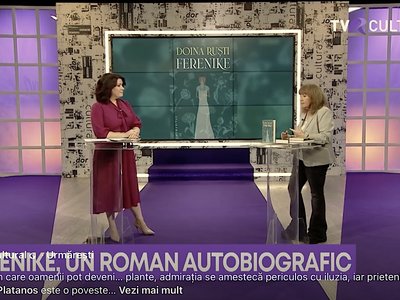
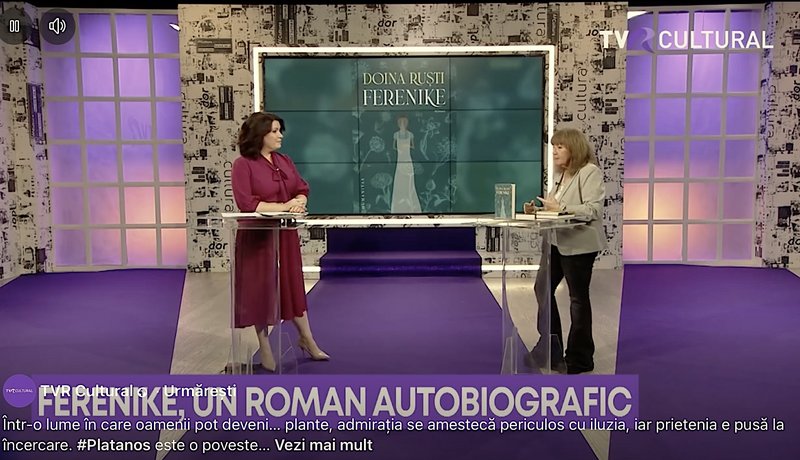
A central place in the discussion was given to the novel Ferenike (Humanitas, 2025), described as the thematic nucleus of her recent work. The book proposes an autobiographical fiction about memory, guilt, and feminine resistance, unfolding across six decades of Romanian history. On this occasion, a continuation was announced: the novel Nas de bulgar, currently in progress.
Ferenike was the subject of 40 public events throughout 2025.
The interview concluded with references to Zavaidoc in the Year of Love, a novel published by Bookzone, which marks the writer’s return to the interwar period. The narrative is constructed from the perspective of a schoolgirl in 1923, who recounts her encounter with Zavaidoc, in a reconstruction of the era’s atmosphere and its cultural mythologies. more
The discussion, conducted by Camelia Văcaru, highlighted a dense and coherent literary year, as well as a position consistently affirmed by Doina Ruști: literature is, first and foremost, an aesthetic act, not an ideological one.
read more