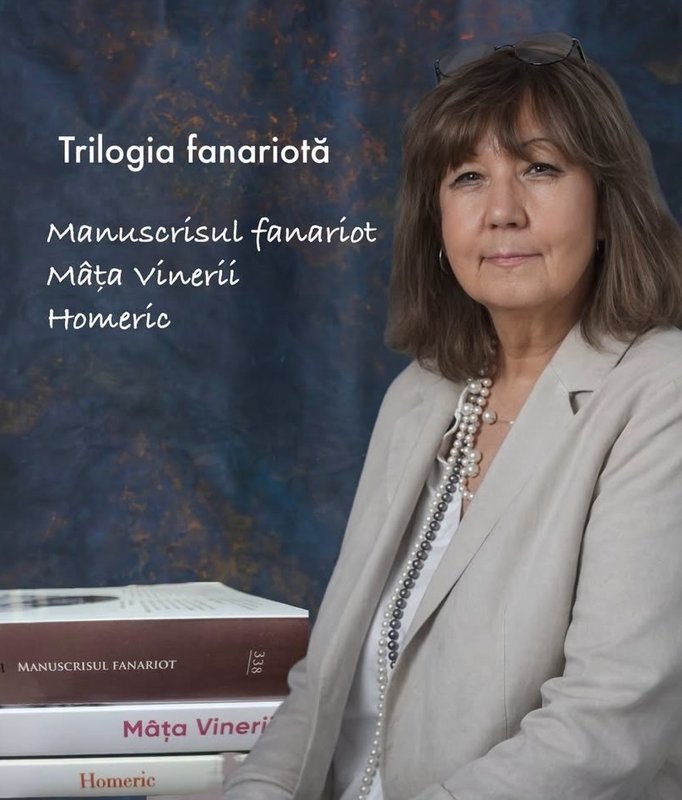
In 2015, Manuscrisul fanariot appeared, the novel that opened up an entire world. From an old document, a contract for the sale of a human being, a trilogy gradually took shape. Mâța Vinerii and Homeric followed, three novels linked by the same age, the same city, and the same imaginary world: eighteenth-century Bucharest, alive, mixed, sensual, violent, filled with love stories, spices, cruel laws, magical recipes, witching plants, and events poised between history and the fabulous.
10 years after the first volume was published, The Phanariot Trilogy remains one of the most extensive narrative constructions devoted to Phanariot Bucharest. Built from archives, chronicles, forgotten words, and old stories, the trilogy reconstructs a restless city, where every street hides a love, a guilt, a trade, a spell.
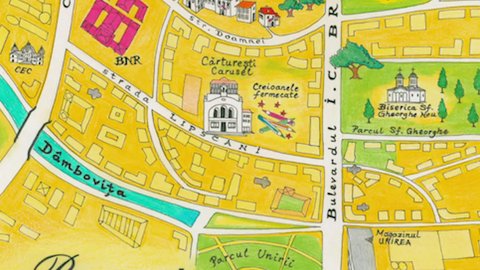
LIPSCANI Street, a Fabulous Geography
The literature devoted to the Phanariot Age changed its message with the fiction written by Doina Ruști. Zogru (2006) and Cămașa în carouri (2010) approach subjects set in the 18th century, but it is only with The Phanariot Trilogy that a specific epic of the 18th century begins to take shape. The novels Manuscrisul fanariot (2015), Mâța Vinerii (2017), and Homeric (2019) bring forth an imaginary world based on the symbolism of “delusion” or “deception”, as an emblem of Romanian Balkanism, and on character types that move beyond traditional exoticism. This Romanian fabulous universe, open toward the Orient and the world south of the Danube, outlines the beginnings of modern Romania.
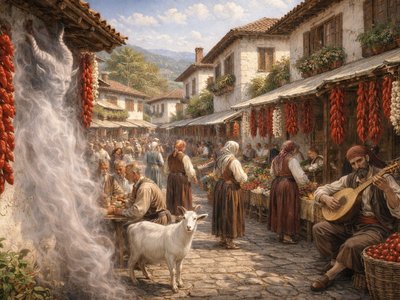
The action of the three novels is set in Bucharest, which becomes a territory specific to the novelist. Cotroceni Forest shelters ancestral mysteries and characters; Bozăria is a place of debauchery and witchcraft; in Lipscani Square the ancestral carob tree keeps watch; and at Gorgan lies the tomb of mythical giants. As a center of the Romanian world, Colțea gathers a complex history in the houses of the Doicescu boyars, while on the banks of the Dâmbovița black storks appear periodically to announce disasters. A tailor in love, cooks concerned with magical recipes and ghostly apparitions, a painter who makes portraits on the wall of a butcher’s shop, and Mărmănjica, a kind of sum of all mysteries, are only a few of the trilogy’s characters. And not least, the slaves, represented through biographies linked to ethnicity and historical becoming, become an essential part of this world’s gallery of characters.
In 2015, Phanariots were hardly ever discussed, and when they were mentioned, little good was said about them. Literature had not presented them in a favorable light either.
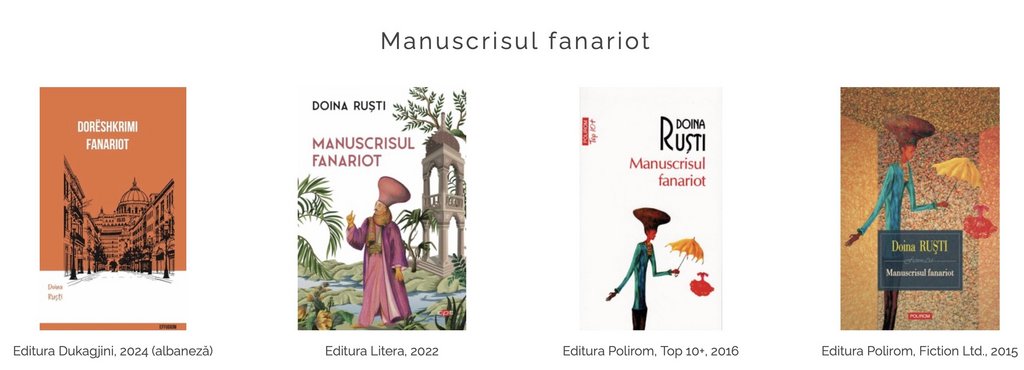
But that year saw the publication of Manuscrisul fanariot, a novel that inevitably brought to mind Eugen Barbu’s Principele and Mateiu Caragiale’s Craii de Curtea-Veche — in other words, Balkanism and the picturesque side of Romanian literature. Yet the novel was more than that, as critics immediately observed.
The lightness of tone is what sets the author of this twenty-first-century Balkan opus apart from the prestigious lineage of her predecessors, all men with weighty styles. Horror, decay, human and moral misery, abject poverty; brilliance, opulence, vivid colors, gentle or wild sounds, refined details; the mixture of Oriental, Balkan, and European elements — all these inherited ingredients are treated without melancholy, that secret, lethal sauce which unifies past and present in our perception of Bucharest through a perverse resignation. Ruști is discreetly omnipresent in her novel, which is not, however, hers in the sense of nostalgic appropriation or dangerous identification with the subject. The author’s empathy exists; it is not merely socially colored, but psychological as well, while the psychoanalytic distance remains constantly visible. From the carefully chosen vocabulary, an impeccable mixture of strict contemporaneity and phonetically charged, baroque archaism, to the concise, precise style of the narrative, which gallops without ostentation from horror to horror, one reads a clinical detachment, doubled by the curiosity of an explorer-adventurer.
Dan Călin, Observator cultural, no. 841
Over these 10 years, Manuscrisul fanariot has opened a path toward the Phanariot world, influencing other writers, renewing the taste for Phanariot splendor, and bringing forward themes that helped re-evaluate Balkan literature.
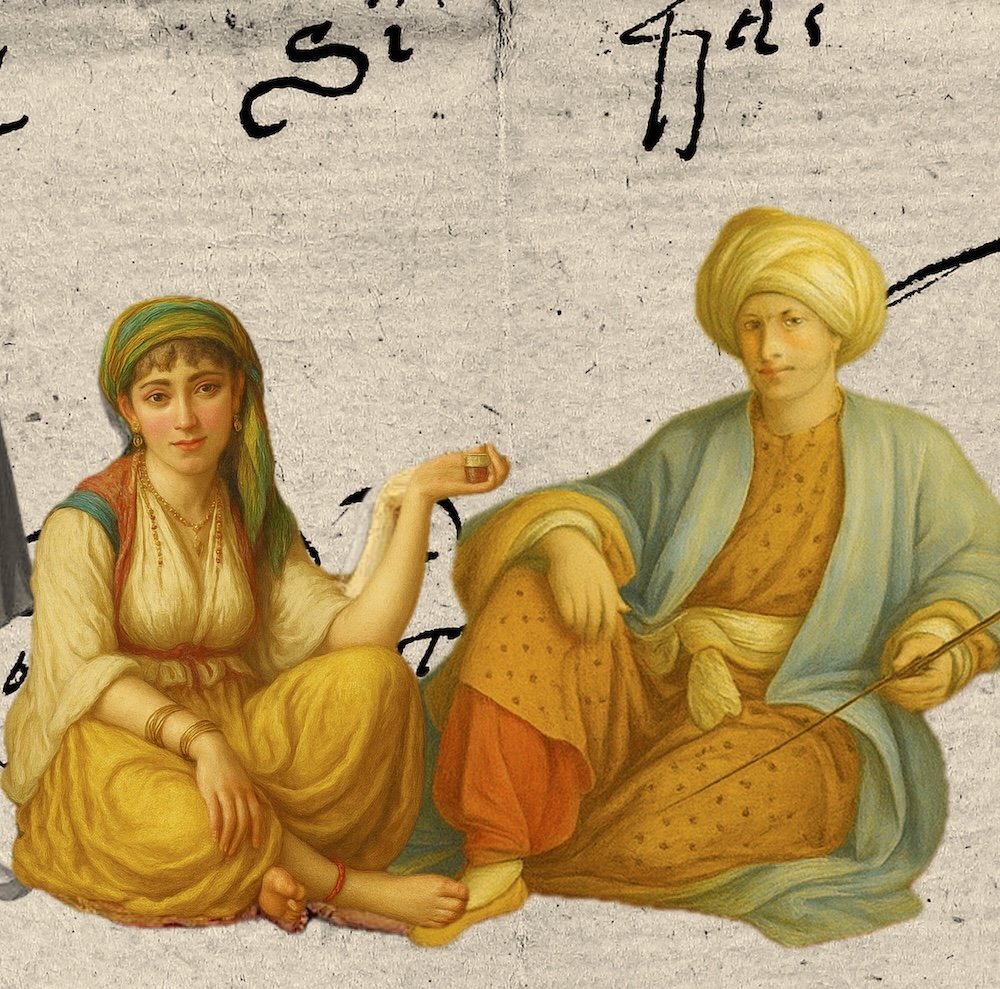
Phanariots. copyright doinarusti.ro
The novel has had several editions, including one in Albanian. It was presented at the Istanbul Book Fair in 2015, and several excerpts were translated into Turkish. A substantial excerpt was published in Trafika Europe, no. 8, 2016.
Mircea Muthu dedicated a chapter to the novel in his prestigious book Balcanismul literar, in the revised 2017 edition.
“A sumptuous book, of contagious sensuality, a poem dedicated to Bucharest.”
Eugen Negrici
Moreover, Balkanism is another defining dimension of her work, manifested as a world of illusion and deception. One of the chapters in The Phanariot Manuscript is devoted to this labyrinthine word, which connects the Mediterranean and Oriental worlds.
Most importantly, however, Manuscrisul fanariot opened a road: the eighteenth century began to be discussed as a formative period for modern Romania. Private documents found in archives came to light, helping to shape a mentality, an anthropological profile. Tudor Dinu wrote Oamenii Epocii Fanariote. Literary criticism approached the novel from cultural and historical perspectives. Emanuela Ilie, Catrinel Popa, and Alina Bako wrote studies on the fantastic re-evaluation of the Phanariot world in Doina Ruști’s novels. Emanuel Lupașcu wrote the short study Bucureștiul fanariot al Doinei Ruști.
Mâța Vinerii is the second novel of The Phanariot Trilogy, published in 2017.
Translated into several widely spoken languages, it became especially visible in its English version: The Book of Perilous Dishes.
Recommended by Amazon booksellers, reviewed by Historical Novel Society, and mentioned by The Guardian, the novel had a British blog tour and several events, including one at the London Book Fair in 2022.
Rosie Goldsmith reads from Mâța Vinerii — English version
The novel was presented at events in Leipzig, London, Budapest, Granada, Madrid, Beijing, and Canton/Guangzhou, China, on a route that included 5 cities.
Critical studies on the novel can be read here. The novel’s bibliography also includes the volume Women’s Imaginary Cooking and Appetites Across Cultures, Cambridge Scholars Publishing, 2025.
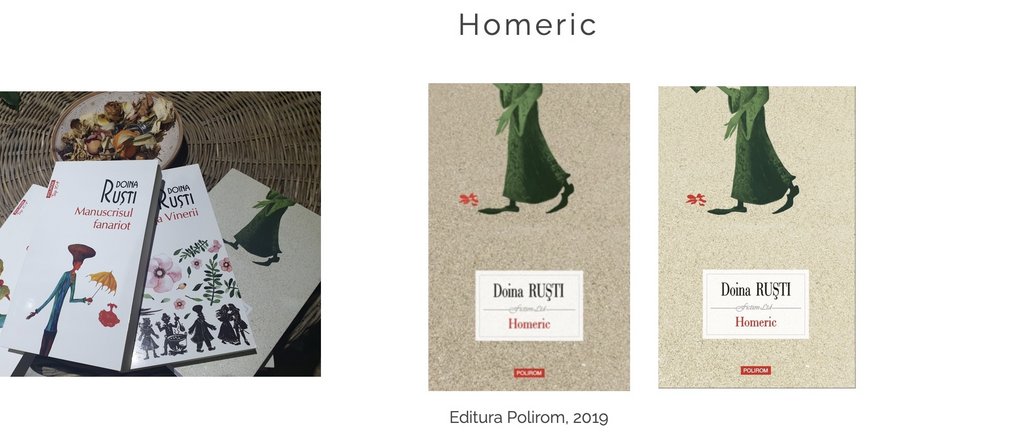
Published in 2018, the novel concludes the trilogy.
Homeric carries the Phanariot world further into a spectacular territory, with lethal perfumes, witching plants, painters, butchers, spirits, passions, and fabulous beings.
The most striking quality of Doina Ruști’s writing, visible in all her books, is the imaginative verve from which her stories are woven, the inexhaustible energy from which characters and narrative threads are born. Although shaped within the conventions of the historical novel, D.R.’s prose uses historical hypotheses as pretexts for exploring fantastic scenarios, intertwining fiction and metafiction in an alloy of magical realism that brings her close to the great South American masters, with whose writing numerous correspondences can be established. More
Mircea Buda, “Homeric or about the Magical Powers of Storytelling”, Acta Marisiensis. Philologia, Volume 1, Issue 1, 2019
More reviews can be read here.

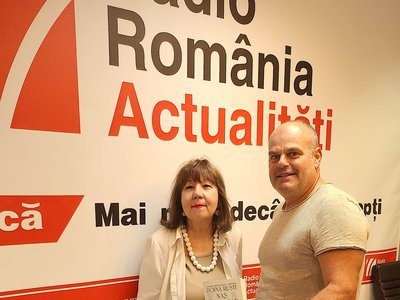
Doina Ruști, Alexandru Papadopol & Homeric
10 years after the publication of the first novel, The Phanariot Trilogy remains just as current, inviting an act of literary archaeology, especially since each novel is accompanied by a map that brings fiction and immediate reality together. This is why critics have also spoken of a literary geography of the trilogy.
In a recent volume, Alina Bako discusses geoliterature and literary geography in Doina Ruști’s prose, placing it in the vicinity of writers such as Slavici, Rebreanu, Hortensia Papadat-Bengescu, Mircea Cărtărescu, and Norman Manea, with an emphasis on the spatial, symbolic, and frontier dimensions of her fiction.
Cartografii ficționale
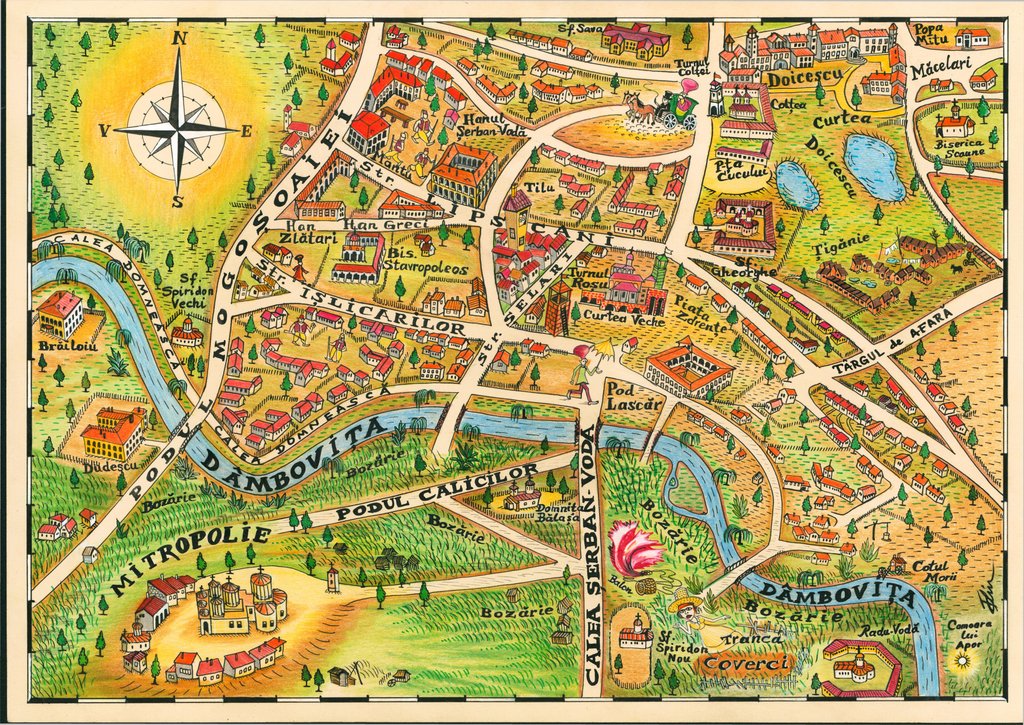
The Phanariot Trilogy brought back into focus an old Bucharest, often ignored or reduced to cliché: a city of trade, mixtures, violence, and seduction, but also a founding space for the modern Romanian imaginary.
After 10 years, the three novels continue to be read together as a literary map: Manuscrisul fanariot opens the document and the drama of freedom, Mâța Vinerii enters the city’s magical kitchens, while Homeric carries the Phanariot world toward its full fabulousness.
Three novels, three entrances into a vanished yet still living city, where history, legend, and fiction touch at every step.
Publishers: