At the Văcărești Monastery lived a certain Onisim, a young monk who handled people remarkably well. He possessed an unusual gift for persuasion and had therefore been entrusted with collecting the debts owed to the Inn of Constantin Vodă. He seemed tireless, running about the city without the slightest sign of effort. He knew where to find those who had not paid, and he knew how to draw money from the pockets of even the most stubborn customers.
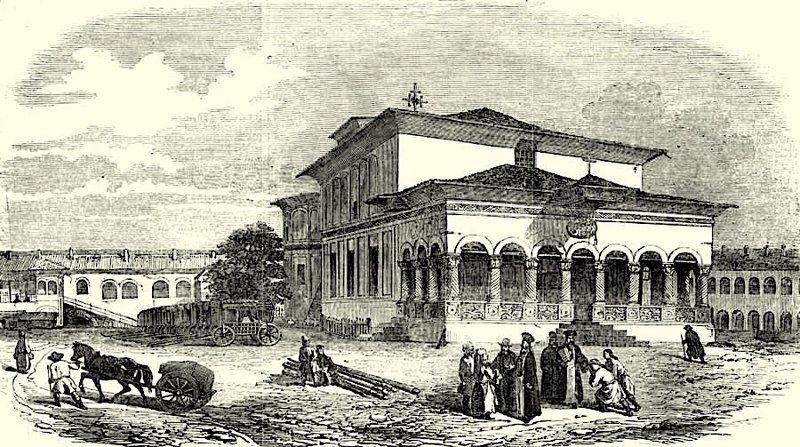
For the inn—situated roughly behind what is today the National History Museum—was frequented by all sorts of characters, especially petty merchants who left their goods there for safekeeping and then vanished for weeks at a time, hoping they might one day reclaim them. But things did not always turn out that way. Customers are fickle people. A poor peddler might buy goods no one wanted anymore—fashions changed, better merchandise appeared, demand disappeared altogether. Unable to pay their debts to the inn, they would hide for a while, attempt some petty swindle, or simply meditate on the chances of making a miraculous comeback.
Onisim always managed to find these bankrupt souls, and somehow he would bring them to the point of settling their debts—sometimes persuading them to donate their merchandise to the monastery, sometimes helping them sell it through methods no one had previously imagined. Onisim knew how to talk. He knew how to set a man in motion.
Once he convinced a bead seller to put on a little blue mantle and parade through the market until he had sold every last bead he carried—despite the fact that they were hopelessly out of fashion and of spectacular ugliness. Onisim even composed a small song for him, which the poor fellow croaked hoarsely as he wandered through the market, clutching his cloak and waving his strings of beads.
In short, the monk Onisim always found a solution. At the end of every day he returned to the protosyncellus with his pockets full of money. And the protosyncellus, in turn, rewarded him with little luxuries pleasing to the eye. Thus it happened that beneath his monastic robe Onisim wore sheer stockings and, above them, fine shalvar trousers made of Maltese silk—something quite rare for a monk.
His days passed peacefully, and life was good.
Until one day.
While knocking on the door of a debtor, Onisim heard a voice not of this world—a voice rising from the underground chambers of the earth itself. It was an irresistible call, a chain of unfamiliar words that drew him forward. He pressed the handle and the door opened with a creak that I will not call sinister, lest you accuse me of resorting to clichés. But between ourselves, it truly did feel like the tail of a snake slipping beneath one’s clothes—the premonition of an inevitable catastrophe.
For two days Onisim failed to return to the monastery. Even the protosyncellus grew worried. Hitching the horses to the monastery’s small carriage, slipping into his canvas shoes and taking up his little sun umbrella, he set out toward the inn determined to discover what had happened.
Following the list of debtors, he eventually reached the door in question and firmly grasped the handle.
Inside stood the missing Onisim—completely naked, wide-eyed, and abandoned by all words.
He was carried back to the monastery and left in contemplation for many days, his muteness naturally attributed to the devil and the numerous branches of his family.
Months passed, and the debtors multiplied. Without Onisim the life of the inn had turned into a millstone. No one could find solutions for the unfortunate debtors; no one knew how to speak to them as he had.
Thus began the ruin of the inn, and not long afterward the death of the most blessed protosyncellus.
Married young to a man uncertain of himself, Firița saw in a single moment the entire life that awaited her. So one summer night, while the moon was beginning to fade and the house was invaded by the grey creatures of sleep, she took the five thalers hidden in a niche and was gone.
You may imagine her dressed in her hesitant husband’s clothes: wide trousers gathered below the knees so that they ballooned like a modern parachute, a shirt, a sturdy vest, and a cloak made from an old blanket.
With those five thalers she entered trade, traveling from town to town selling wire brushes piled high on a cart she had built herself. Seen from afar she looked like a ragged soul dragging behind her a gigantic hedgehog. But seen up close she stopped people in their tracks: her gaze struck you straight in the calves, and she seemed to carry small goblins perched upon her right shoulder.
No one could remain indifferent to such a rare apparition. One had the impression of having finally encountered the long-awaited new Jesus.
Taking advantage of her appearance and instinctively avoiding too much conversation, she eventually achieved a certain balance—financial as well as personal. Bucharest no longer held many mysteries for her, and the Inn of Constantin Vodă had become her true home.
Still, there were bad days.
Such as the day when Onisim arrived to collect money and knocked at her door.
At first she rushed to slide the bolt across. But without thinking she began to hum softly, almost under her breath—the way one does when brushed by the wing of fear.
The meeting with Onisim struck her like a blow to the forehead. Yet she did not stop; she continued her melody.
Strangely enough, he too remained motionless, his tongue as if eaten by moths. She let him in and closed the door behind him without asking what he wanted.
It was clear that Onisim had been struck dumb with astonishment, for beneath the thin fabric of her shirt two nipples moved—and as everyone knows, such things are responsible for the illness of muteness.
Yet this was not the true cause of Onisim’s silence.
That came later—after Firița had been fascinated by the monk’s delicate stockings that begged to be touched, after they had spoken of fine fabrics and foreign merchandise, and after the two days and nights in which Onisim fell into sin and Firița reconsidered her freedoms.
His muteness arrived one morning when he woke without clothes. Before he had time to gather his thoughts, the door opened and there in the doorway stood the protosyncellus, holding a little umbrella.
At that moment his voice fled him. At that moment a rope seemed to grow inside his throat.
Meanwhile Firița, who had slipped past the prelate imagining perfectly well what scene was about to unfold, was already taking long strides down the road, convinced she would not soon return to that inn.
Yet as the distance between her and the monk Onisim grew, she began to realize that what she had taken for a simple adventure had become the most important event of her life.
And yet the two never saw each other again. She did not seek him because she had no idea what mystical impression she had produced. And he did not seek her because he had lost not only his voice but also his faith in rhetoric.
Thus their bond was reduced to those two eternal days—preserved here, and now also in your thoughts.