Everything began behind the Church of St. Sava, where at the time there lay a garden of weeds, the remnant of an old cemetery. A few ancient stone crosses could still be seen there. Beneath a blueberry bush began the immortal life of Elina, the wife of an ișlic-maker.
Married only a few months, this woman—who through her deeds would one day draw a map of rare pleasures—crossed the city every day. Her husband was a celebrated maker of ișlic hats, so devoted to his craft that every cap leaving his hands was a masterpiece. He made mostly globular ișlics of broadcloth in every color imaginable, but also of finely dyed leather, thick silk, even hemp softened with the occasional thread of silk. He owned an excellent wooden mold, on which he stretched any material to perfection. When the work was done, Elina loaded the carriage with monumental ișlics and carried them to their customers, collecting the payment with infinite pleasure—mostly silver coins, but also thalers or lesser coins, all good money, sorted by value into cotton or leather purses, or slipped directly into the pockets of her skirts or into her bodice.
Yet this perfect life had a crack in it.
One day Elina had to deliver an order to St. Sava, for a schoolmaster. To shorten the way, she stopped the carriage beside the church and, dragging behind her the basket in which a splendid ișlic rested, cut across the weeds. Somehow, beneath the sun of a day thick with scents and temptations—perhaps at the touch of a fairy’s finger—Elina suddenly found herself face to face with a man.
He was dressed in silk, a figure who seemed to have fallen from the sky, and to confirm the impression he began speaking in a mysterious language. Elina stood motionless, staring at the stranger’s lips as they formed strange words. Then the man took out a notebook and began to draw. His hair, tied in a tail, had slipped behind his ear, and his eyes shone strangely beneath the shade of a rather loose fez.
Elina remained standing for a moment, but when the man beckoned she approached without the slightest hesitation. On the white page he had drawn her portrait exactly as she stood, one hand resting on the basket. There was something inhuman about the whole encounter. The tall hollyhocks, the hemlock, and the surrounding bushes made the scene seem detached from ordinary life. What followed was spontaneous and almost mystical: a swift union beneath the blueberry branches. Several hollyhocks snapped, the man’s fez rolled toward the fence, and Elina lost a tassel from her shoe.
When she stepped out of the churchyard she was another being, and the event had already risen into the heavens among those deeds that never die.
A few days later she stopped to buy some thread from a peddler. The man told her he had more goods at Chiriță’s Inn, where he lived, and Elina offered to accompany him. The thread seller was shocked, but it seemed to him it was not his place to judge her.
The room at the inn was like an eye over which a delicate eyelid trembled. Through the barred windows one could see the crowns of the lime trees, and upon the bed the shadows of subtle beings drifted lazily. What had begun as a small transaction turned into a passionate struggle. The floor was carpeted with Elina’s many skirts, while the man’s loose trousers ended up on the windowsill. Nothing she had known until then could compare with that afternoon, presided over by a faun. The seller of needles and thread melted within the hour and, in his new state—of milk and honey—slipped slowly beneath the skin, dissolving through the vast territories of heated flesh.
The next day Elina was seized by panic, asking herself questions about duty and guilt. In that state she entered Barbers’ Street to deliver some ișlics. But when she had finished her business and was walking back toward the carriage waiting at the edge of the street, she noticed someone watching her. A man leaned against a wall—wide-eyed and somewhat scrawny. She tried to ignore him, but from his lips slipped a melody, almost under his breath, as if whistled by the wind. She glanced again, and the man—who now could be clearly seen holding a cane with a silver handle—beckoned her toward him.
He had not spoken; he was surely some rogue. And yet Elina’s feet seemed tied to him. With small steps that at first glance suggested hesitation but were in fact driven by emotion, she reached a gate. From the balcony fell a curtain of honeysuckle, and from the garden came the call of an angry cuckoo.
Elina remained many hours in the stranger’s house. The curtains were drawn, and in the dim light the man seemed made of tobacco smoke. Later, during the many nights that followed, she could no longer remember the features of his face, though she remembered everything else. She had no doubt that the man from the honeysuckle house vanished together with her desires.
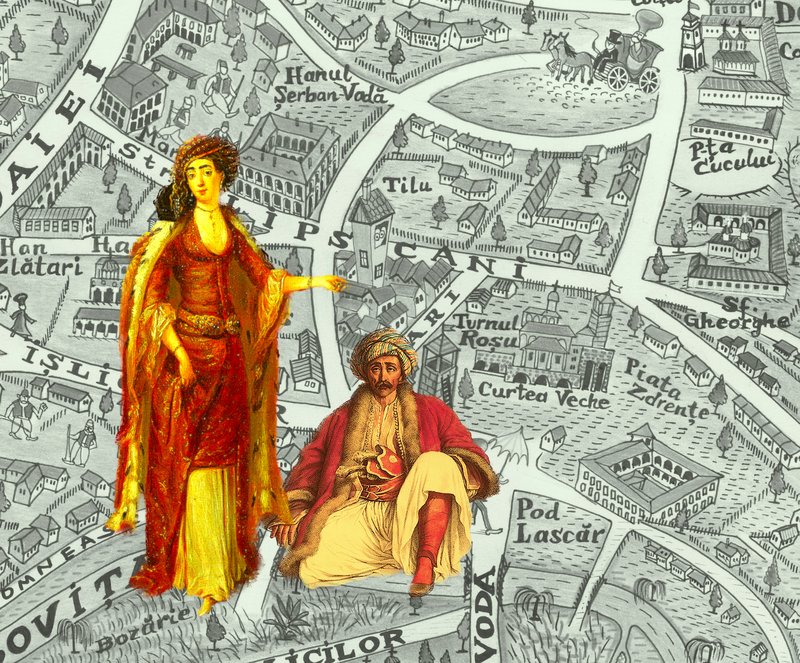
From that day on, the city changed its geography for Elina. From the swarm of people, the heap of houses, and the countless streets, only three places remained that mattered. Though she met other men afterward, none were granted entry onto the secret map. In the sweet world of pleasure and debauchery, life continued to pulse at St. Sava, at Chiriță’s Inn, and on the immortal Barbers’ Street.
(Doina Ruști - din Depravatul din Gorgani, ed. Litera 2023)