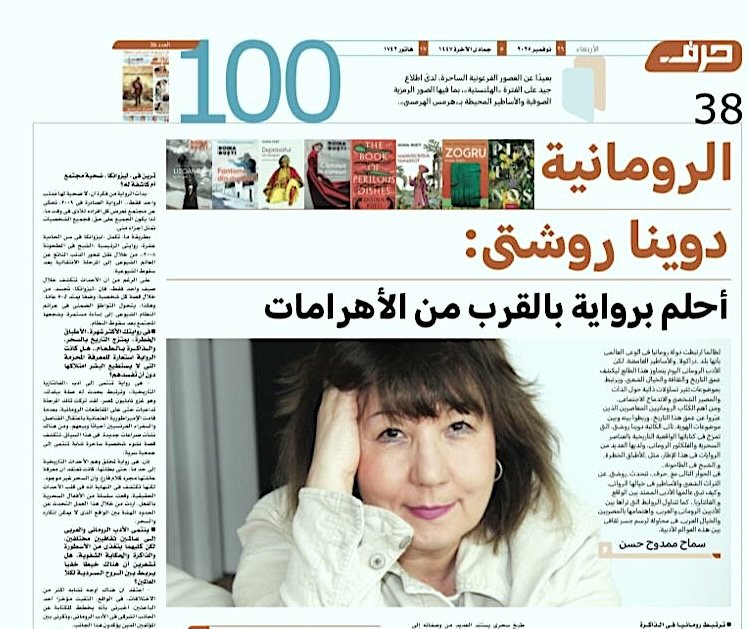
Doina Ruști: Dear Samah, I’ve always been glad that we’re associated with Dracula. It would be far worse if no one knew anything about us! :) In fact, this symbol has intrigued me to the point that I wrote a novel titled Zogru (2006), about an entity that travels through the centuries. I believe vampire literature still has stories to tell. However, I must say that this theme doesn’t hold much importance in Romanian literature. As everywhere, identity writing dominates—by which I mean a confessional form that raises subjective questions about the self, personal destiny, and social integration. I don’t think that, in today’s global chaos, any theme tied to national spirit or identity still carries much interest.
Romania is a land where folk tales intersect with history, and magic intertwines with cruelty—from Dracula to the rural legends that appear in your works. Does this fantastic heritage serve as a direct source of inspiration for your imagination, or is it an inseparable cultural backdrop when you write about memory and identity?
Folklore has always been among my passions, and fantastic literature has both fascinated and delighted me. Therefore, I cultivate a kind of fantastic situated at the border between myth deconstruction and the fabulous imaginary—often with a realist substratum. Romanian and universal myths reached me through scholarly channels, under the influence of South American literature. My formative years took place under communism, during Ceaușescu’s sad dictatorship, when religion was despised and anything mystical was labeled obscurantist. So I can’t boast of a living, oral folklore experience. As a child, I was far more familiar with The Thousand and One Nights than with Romanian myths or beliefs. I discovered Romanian folklore books only with great difficulty—many were kept in the “secret collection” of the National Library, where access was strictly restricted. Only after the fall of communism did a mythical reevaluation explode, one I also took part in.
Yet, in my own writing, I’m mostly concerned with the fabulous itself. In my novel The Book of Perilous Dishes (Mâța Vinerii, 2017), there appears a magical cookbook. Many of its recipes have roots in medieval European manuals, including one inspired by Avicenna (Ibn Sina), but some also come from my family’s kitchen. Beyond that, however, lies my own private imaginary world.
Your works are rooted in a rich mythological world, from guardian spirits to magical recipes and enigmatic symbols that fill the Romanian rural imagination. Which folk legends have left the deepest imprint on your literary imagination? Do you consider returning to oral traditions a way to understand the Romanian self in a turbulent present?
Most of my novels are set in Bucharest, and I draw upon urban myths, many recorded in chronicles or private documents. I’m a passionate reader of writings without “official” historical importance. For example, in an 18th-century document from a princely chancery, I found a police report that caught my eye. It stated that one morning, a dead vampire had been discovered. His body was lying on a well-known Bucharest street (which still exists today). The report described the unidentified corpse in detail: very hairy, with a tail, long nails, and a diabolic appearance. Completely naked. The origin of this strange being remained unknown.
After consulting other documents from the same period, I formed an idea and wrote a short story about a chancery clerk who spent his days drafting official acts, and his nights sneaking into women’s bedrooms in search of romantic adventures. Caught one night by a husband, he jumped from the window and died. Naked and hairy, he made a poor impression—thus he was taken for a vampire (Amorous Oddities from Phanariot Bucharest, 2022).
In other stories and novels, I’ve created a fantastic dimension around well-known historical events. In Homeric (2019), for example, the narrative develops around a mound in Bucharest called Gorganul, which still exists. Much has been written about it, but no one really knows what lies beneath. So I imagined the tomb of an extinct human race—a tribe of giants whose burial site is the Gorganul.
I’m also fascinated by folklore myths. One of them, collected in the 19th century, struck me so much that I must tell it to you: two young devils duel over a woman, and one dies, turning into tiny granules. The Lord of Hell is astonished, for this was the first mortal devil. Deeply affected, he orders all devils to gather the remains and scatter them throughout the world so that everyone may share in his sorrow. From those granules grows a plant with amazing large leaves, and humans, irresistibly drawn to it, begin to smoke it—thus becoming very sad. It’s a legend of tobacco, rich in details, and a perfect seed for a novel.
In your recently published book Ferenike, you blend autobiography with fiction to revisit a formative event from your childhood—the assassination of your father—transforming it into a meditation on memory, identity, and fate. To what extent can the book be seen as an attempt to write the self from within a historical wound rather than from the outside? Does the novel succeed in turning personal pain into collective awareness of history, femininity, and power?
Ferenike is also a novel about communism and about the condition of women in that era. I tried to speak both about myself and about the historical events in which, in one way or another, I took part—such as the Vietnam War, Ceaușescu’s decrees, and the fall of the Iron Curtain. The novel reveals a mechanism of conflict that has not yet lost its function. What happened yesterday is repeated today. I was preoccupied both with the narrative form and with the artificial way in which the communist world was constructed—with its planned prohibitions and self-censorship. I sought to understand my “discoveries” in a society where there was no information, and no place to find it.
One of your most controversial novels, Lizoanca at the Age of Eleven, portrays childhood as a mirror reflecting the corruption of the world rather than innocence. Did you see Lizoanca as a victim of society or as someone exposing it? How did you navigate the fine line between depicting pain and reproducing violence in literary writing?
I started from the idea that no victim has only one culprit. In Lizoanca (2009), the story belongs to a community in which every individual has, at some point, been a victim. Therefore, everyone is right; all the characters are parts of myself.
The novel sparked wide discussion on the representation of the female body and childhood, with some critics linking it to your persistent tendency to expose the moral structures of society. To what extent do you consider this novel a turning point in your literary awareness of the concept of collective guilt?
In a way, Lizoanca at Eleven completes my main novel, The Ghost in the Mill (2008), by carrying forward the guilt of the communist world into the post-communist transition. Though the action unfolds over a single summer, Lizoancasynthesizes, through each character’s story, a situation spanning fifty years. Thus, the tacit complicity in communist crimes transforms into a permanent, socially encouraged abuse after the regime’s fall.
In your most famous novel, The Book of Perilous Dishes, history merges with magic, and memory intertwines with food, set against 18th-century Bucharest. Was the book intended as a metaphor for forbidden knowledge that humans cannot possess without being corrupted? Or is it an allegory for humanity’s desire to control the unknown through language, food, and storytelling?
The Book of Perilous Dishes is the English title of Mâța Vinerii, a work of historical fantasy. It’s linked to an event connected to your own country: Napoleon’s invasion of Egypt. That episode had repercussions even in the Romanian principalities, where the Ottoman Empire arrested and sometimes sold the French consuls and ambassadors. From there, new conflicts arose. Against this background unfolds the coming-of-age story of a young witch who belongs to a secret confraternity.
So it’s a novel that creates the illusion of historical events—up to a point. Even Mâța Vinerii, the narrator, believes that her family’s knowledge is nonsensical, that magic doesn’t exist—only to discover eventually that, at the heart of real events, a series of magical acts have indeed occurred. I wanted to speak here about the fragile border between undeniable reality and magic.
Romanian and Arabic literature belong to different cultural worlds, yet both draw nourishment from legend, memory, and oral storytelling. Do you feel there is a hidden thread connecting the narrative spirit in Romania with that found in Arabic literature? How do you see storytelling as a bridge that transcends language and history?
I think there are more connections than differences. In fact, I recently met a scholar who told me he plans to write about the Oriental aspect of Romanian literature—and mentioned me among the authors who confirm it. The historical influence of the Ottoman Empire has left deep traces in our literature. Centuries of economic and political relations with the Turks, who appointed our rulers and shaped our imports—both material and cultural—have created mentalities that persist to this day.
We must also remember that the Turks built their empire on a Greek cultural foundation, which harmonizes with our European and Balkan background. Hence the frequent statement that Romania is “the most Oriental of the Latin countries,” situated at the Gates of the East. From this origin emerged a literature of isarlâcuri—stories filled with invisible spirits, flying slippers, and dragons that bring rain and guard precious stones. Writers like Ion Barbu, Urmuz, Mateiu Caragiale, Eugen Barbu, and many others have created a literature infused with Oriental symbolism and atmosphere—and I, too, belong to that lineage.
In recent years, there has been growing interest in Romania in translated Arabic literature, and in the Arab world in Romanian literature. Although Romania borders the Black Sea rather than the Mediterranean, it culturally belongs to a broader space where Eastern and Western civilizations intersect. Do you think this exchange can create a kind of “literature across the seas”? What can Arab and Romanian writers learn from each other in understanding humanity and imagination?
In Romania there has always been a fascination with the Orient. The first example that comes to mind is Sadoveanu, an interwar writer who placed the ancient mysteries of our forebears in Egypt. Egypt is a universal world—a crossroads where civilizations mix. My own points of reference are varied. Beyond the fascinating pharaonic antiquity, I’m well-acquainted with the Hellenistic period, with its mystical imagery and the legends surrounding Hermes Trismegistus. Yet I must admit I know little about the contemporary world. I remain attached to Lawrence Durrell’s cosmopolitan, baroque Alexandria, and I recently read André Aciman.
But yes, I’m absolutely convinced that our world is interested in Egyptian writers. I don’t know if the interest is mutual, or whether any Romanian authors have been translated into Arabic. Surprisingly, in the early 1980s, during a time of strict censorship, a novel by Assia Djebar (Les impatients/The Impatient Ones) was translated into Romanian, and I devoured it. It was the first time I read an Algerian writer. The experience of entering an unknown world is always unforgettable. That’s why I think it would be useful to have small presentations of Egyptian writers, perhaps in the magazine Ficțiunea. Maybe you’ll write them! :)
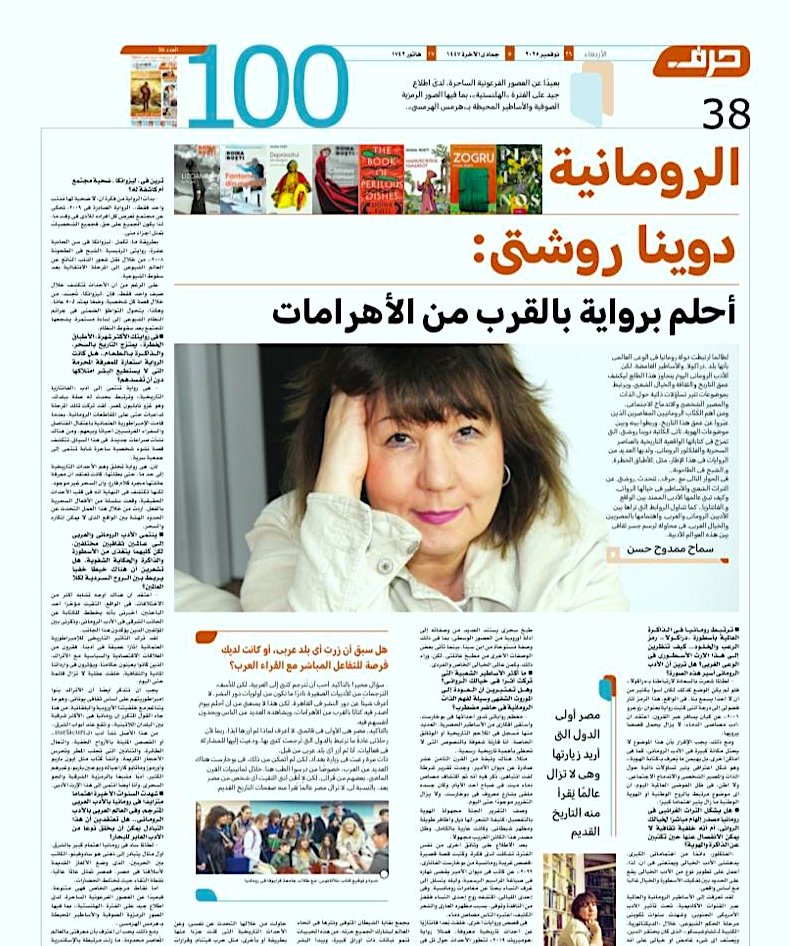
Many Arab readers find in your works a mixture of Eastern spirit and magical realism, as if speaking to their sensibilities in their own language. Have you ever considered having your books translated into Arabic? How do you imagine Arab readers responding to your worlds that blend cooking, magic, and history?
As I mentioned, I’ve read Arabic literature only occasionally, but I am a potential reader—certainly curious about Egyptian literature.
Have you ever visited any Arab countries, or had the opportunity to interact directly with Arab readers? If not, which countries would you most like to visit? Does Egypt, with its history and civilization, represent a space close to your literary imagination?
A trick question! :) I would love to be translated into Arabic, but unfortunately, translations from small literatures are rarely anyone’s priority. I know nothing about publishing houses in Cairo, but that doesn’t stop me from dreaming that one day I’ll launch a book near the pyramids—and that many people will see themselves reflected in it.
Of course, Egypt is first on my list! I don’t know why I’ve never been there—perhaps because my travels are usually linked to countries where my books have been translated and I’m invited for events. I’ve never been to an Arab country. I once wanted to see Baghdad, but didn’t manage to. In Bucharest, there are many Arabs—especially those who studied medicine here during the 1980s. Some of them are my readers. But I don’t think I’ve met anyone from Egypt yet. For me, it remains a world from the pages of ancient history.